OOO
Part One: Science
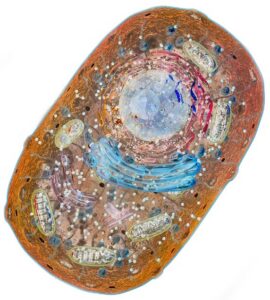
Autopoeisis
“Autopoiesis is the act of creating an identity.”
Francisco Varela
In 1972, Neurobiologists Humberto Maturano and Francisco Varela proposed the generative concept of “autopoiesis,” which boldly proposed that living things not only create and sustain their own bodies, they also create a kind of subjectivity: a sense of being in a world.
The smallest living thing, a single cell, is a seething cauldron of tangled biochemical interactions, more like a busy city than a factory. Countless organic molecules swimming in a protoplasmic sea of intricate organelles, catalyze or inhibit reactions, depending on current condition both inside and outside the cellular membrane, all in the service of staying alive. These mind-bogglingly intricate interweaving transformations evidently assume a continuing pattern or rhythm, a beat we may call metabolism: the cell behaves as though it wants to stay alive. Even microbes flock to a feast and flee from danger. Sensation has somehow become possible, along with feeling and desire: in a word, sentience. (And who can say if a single cell’s feelings are less intense than those of multicellular beings like us?) In a sense, what cells do depends on how they feel about their surroundings. Somehow, somewhere, primordial clusters of molecules discovered how to feel — and the planet Earth would never be the same. In this interpretation of autopoiesis, bodies, feelings, and sentience are all the same process. To put it very simply, mind and body are not different things, they are inseparable aspects of the processes of life.
…..
OOO
“By using the term embodied we mean to highlight two points: first that cognition depends upon the kinds of experience that come from having a body with various sensorimotor capacities, and second, that these individul sensorimotor capacities are themselves embedded in a more encompassing biological, psychological and cultural context.”
(Francisco J. Varela, Evan Thompson, and Elanor Rosch “The Embodied Mind: Cognitive Science and Human Experience (172–173).
OOO
The groundwork for the sciences of embodied cognition was laid by the phenomenologist Maurice Merleau-Ponty who, rare among philosophers, made “the body” the chief focus of his thinking. In The Phenomenology of Perception (1945) he painted a picture of body and world interacting through the medium of the senses. For Merleau-Ponty the fact that we are embodied means that there is no definite distinction between subject and object. Our animal senses reach out and touch the world, and are touched by it, in such an intimate way that it is difficult to say exactly where one leaves off and the other begins:
OOO
“Our own body is in the world as the heart is in the organism; it keeps the visible spectacle constantly alive; it breathes life into it and sustains it inwardly, and with it forms a system.” (9)
OOO
Varela’s “embodied cognition” offers an explanatory paradigm in which intelligence is not understood as Descartes’ incorporeal observer, nor as the computer-like processing of symbolic representations; rather, embodied cognition is an emergent property of recursive feedback loops among the organisms’ bodies and the environments in which they must survive. From the perspective of embodied cognition, the world is not simply a reality “out there:” an organism’s world emerges as an umwelt: an experienced reality based on the organism’s bodily capacities and it’s environmental “affordances”—aspects of the world that the organism is able to interact with in order to survive. Oak trees provide affordances for squirrels in the form of habitat, refuge, and sustenance.
ooo
The dynamic mutual formations between organisms and environments is called “enaction.” Through enaction, sentience makes physical changes in the world: organisms’ value-based decisions alter their environment: squirrels afford aid to oaks by propagating their seeds. Organisms’ bodies are shaped as well by enactive feedback loops of evolution and ecological regulation. The tint and fragrance of the wild roses is engendered by the passions of bees; the passions of trees create the air we breathe; the whole blooming, buzzing, chirping, chattering world is a massive collaborative work of art, always in progress. Subjectivity is a material power: sentience shapes the world.
ooo
Abundant neurological evidence supports the embodied cognition model, as the neuroscientist Antonio Damascio presents in Descartes’ Error: Emotion, Reason, and the Human Brain:
OOO
“The physiological operations that we call mind are derived from the structural and fictional ensemble [of brain, body, and interactions with the environment] rather than from the brain alone: mental phenomena can be fully understood only in the context of an organism’s interacting in an environment. That the environment is, in part, a product of the organism’s activity itself, merely underscores the complexity of interactions we must take into account.” (xvii)
OOO
OOO
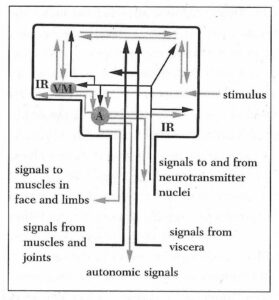
Damascio’s meticulous research revealed that embodied feelings and emotions structurally precede any kind of cognition: the body’s sense organs, skin, various plexuses, and endocrine systems all in some sense “think” and are in communication with the brain, the world outside the body, and with each other, creating a veritable symphony of recursive feedback that creates, in his terms a narrative, which is the organism’s subjectivity. Our experience of thinking as a kind of silent talking in our heads can only occur on the reflective surface of innumerable, deep, speechless, somatic processes of feeling and sensing. Not all intelligence is performed as discursive thought.
OOO
….
….
The meaning of life
[M]eaning is not just a matter of concepts and propositions, but also reaches down into the images, sensorimotor schemas, feelings, qualities, and emotions that constitute our meaningful encounter with our world.
Mark Johnson “The Meaning of the Body” (xi)
ooo
All animals and people have the same core emotion systems in the brain. . . . Human beings have a much bigger neocortex, but the core emotions aren’t located in the neocortex. They’re in the lower-down part of the brain.
Temple Grandin and Catherine Johnson “Animals Make Us Human: Creating the Best Life for Animals” (5)
OOO
Philosophers Mark Johnson and George Lakoff studied neuroscience to understand how the sensory interplay of organism and environment engenders values and meanings. An organism’s values self-organize around it’s needs; meanings arise from these values as it navigates its environment. For non-humans, these meanings are nonverbal: they take the form of sense qualities and feeling tones. For example, a fish will value other fish differently — as friend, food, danger, etc — and those values will determine what they mean to the fish.
ooo
Lakoff and Johnson detail how even the most sophisticated human concepts originate in “image schemas:” pre-linguistic neural patterns that are formed by our primal embodied experiences, which patterns become the fundamental metaphors with which we order our language. These metaphors can be things like the sense of weight, up/down orientation, the qualities of hard/soft, fast/slow, and so on. Feeling generates values, values generate meanings; all of them emerge from bodies in interaction with the world.
…
….
Biosemiotics: the language of nature
Biosemiotics is the idea that life is based on semiosis, i.e., on signs and codes.
Barbieri, M. “Biosemiotics: a new understanding of life”
…
Pioneered by researchers Jesper Hoffmeyer, Kalevi Kull, and others, biosemiotics treats living processes not as simple mechanical operations that always work the same way, but rather as communicative and interpretive acts performed by sentient beings, be they elephant, slime mold, or human. Environmental affordances appear, not as mechanical causes, but as signs to be interpreted. Even single cells have been observed to exhibit a kind of intelligence by responding to similar stimuli in different ways depending on environmental conditions, as if they had interpreted the chemical signals around them and chosen an appropriate action.
The base language of living nature is necessarily non-verbal; it consists of embodied, feeling-toned sense qualities — and it is a language of performance. Embodied language connects beings in relationships that are both material and meaningful. Bees value nectar, so the shape and scent of flowers take on meaning for them. They use movement language to communicate the location of resources to their hive mates. For a wolf, the growls, yips, and scents of her pack-mates carry meanings that are the emergent expressions of their animal bodies and relationships. The entire living world comes to be by the self-organizing intelligence of perceptive, feeling, expressive beings whose entangled desires culminate in today’s grand performance of life, with all its spectacle and song, comedy and tragedy.
OOO
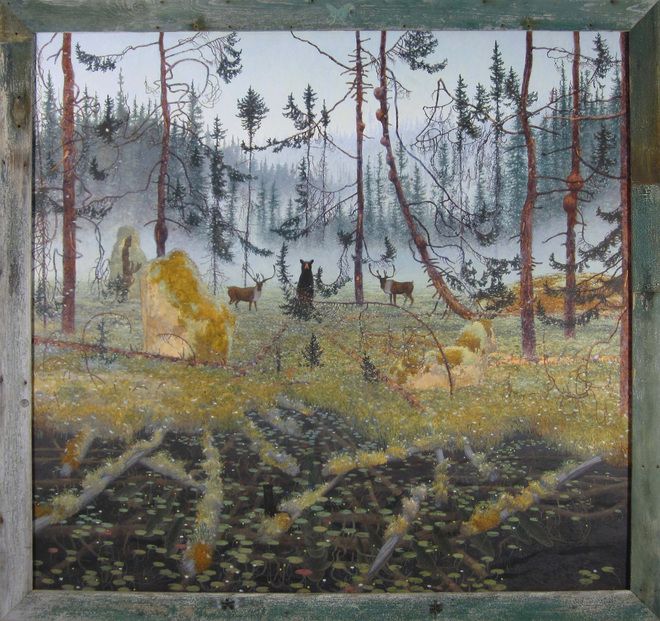
Tom Uttech MAKWA PINDIG-WABASHKIKI (900), Oil on Linen, 66 1/2 x 71 1/2″ framed – Photo credit: Sean Bodley
ooo
Part Two: Art
Part Two: Art
The biopoetics of ecophilosopher David Abram and biologist Andreas Weber weave a transformative vision of the human/nature relationship.
OOO